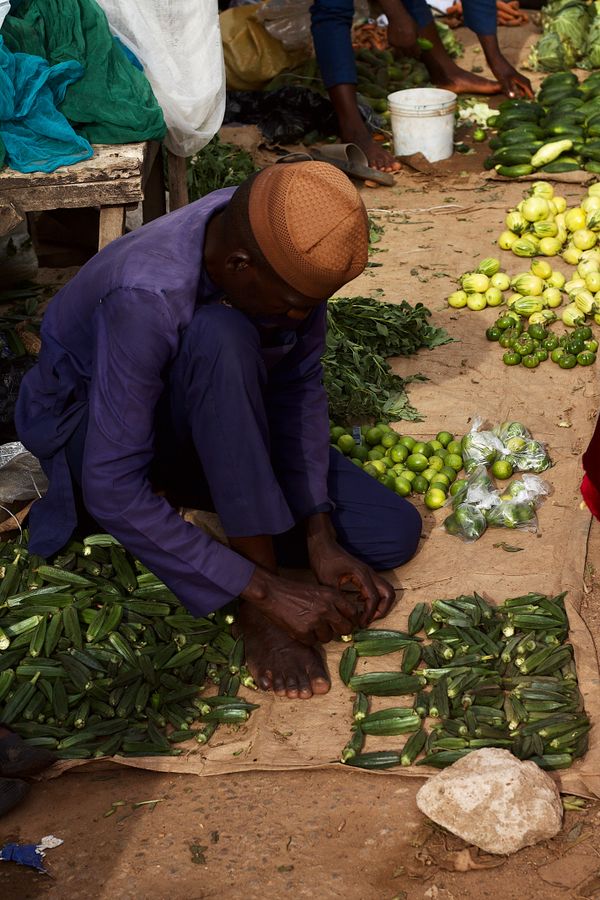
Market day as the centre of the local produce economy
For most of our members selling any surplus at all, Babadogo's Saturday market day is where that selling actually happens, rather than through any more formal retail channel. Understanding how pricing and positioning actually work at market day is, for many members, as important a skill as growing the produce itself.
How members set prices
Most members set prices informally based on what similar produce is selling for elsewhere in the market that same morning, adjusted for the specific quality and freshness of their own stock, rather than working from any fixed price list. The digital tools article on this blog covers how some members now check published market price information ahead of time, which has meaningfully strengthened members' confidence in negotiating rather than simply accepting whatever price is first suggested by a buyer.
Members newer to selling sometimes underprice their produce out of uncertainty, and part of what more experienced members and our trainers help with informally is building the confidence to hold a fair price rather than discounting immediately at the first pushback from a buyer.
Positioning and timing at the market
Where a seller sets up within the market, and how early they arrive, both affect how quickly produce sells and at what price. Early arrival generally means better positioning and first access to the morning's buyers, though it also means longer hours standing at a stall; several members coordinate with a neighbour to share a stall and split the hours, which has become an informal extension of the same cooperative habits that drive our group buying and table banking programs.
Managing what does not sell
Produce that has not sold by the time the market winds down presents a real decision: sell at a steep discount to avoid a total loss, take it home for household consumption, or, for members who have taken up basic value addition, set it aside for drying or preservation rather than selling at a loss. This decision point is exactly where our value addition training has made the most direct, visible difference for members who previously had no good option beyond an immediate discount sale.
What we have learned from watching market day over time
The clearest pattern we have observed is that members who diversify what they bring to market — a mix of leafy greens, a seasonal specialty, perhaps a small value-added product — tend to have steadier income across the year than members who bring only a single crop, since a diversified stall is less exposed to a single crop's price swings or a single week's poor harvest. This observation now shapes how we advise members thinking about what to plant for market rather than purely for household consumption.
How new sellers build initial buyer trust
A first-time seller at market day starts with no established buyer relationships, which is a real disadvantage compared with sellers who have built a regular customer base over years. We advise new sellers to focus initially on consistent quality and honest, straightforward interaction with buyers over aggressive pricing strategies, since building a small base of repeat buyers who trust the quality of what a seller offers tends to produce more stable income over time than chasing the lowest price to attract one-off buyers.
Several of our newer sellers have found that positioning near, and being introduced by, an established member seller considerably speeds up this trust-building process compared with setting up entirely independently for the first time.
The clearest lesson from watching market day over time is that a diversified stall — a mix of crops and, where possible, a value-added product — tends to produce steadier income across the year than relying on a single crop alone. This observation now directly shapes how we advise members thinking about what to plant not just for household use but specifically for market. We continue to observe and learn from market day dynamics each season, and the informal guidance we offer members around pricing, positioning, and diversification reflects an accumulating, evolving body of practical experience rather than a fixed set of rules — market conditions shift, and our advice shifts somewhat alongside them.
Key takeaways
- Babadogo's Saturday market day is the primary selling channel for most member surplus.
- Prices are set informally based on same-morning comparisons, adjusted for quality.
- Early arrival generally means better stall positioning and first access to buyers.
- Diversifying what's brought to market produces steadier income than a single crop.
Frequently asked questions
How do members decide what price to charge?
Informally, based on what similar produce is selling for elsewhere in the market that morning, adjusted for freshness and quality.
What happens to unsold produce at the end of market day?
Members either discount it steeply, take it home for household use, or, if they've taken up value addition, set it aside for drying or preservation.
Can new members share a market stall with someone experienced?
Yes — several members do this informally, which also helps split the long hours of standing at a stall.
Is Babadogo's Saturday market day open to non-member sellers too?
Yes — it's a public community market; our members simply make up a portion of the regular sellers there.