Rainfall is no longer reliable
For decades, farmers across Kenya planned around two predictable rainy seasons: the long rains from March to May, and the short rains from October to November. Members with long farming experience report that this predictability has weakened noticeably in recent years, with rains arriving late, ending early, or falling in short, intense bursts rather than steady showers.
Adjusting planting calendars
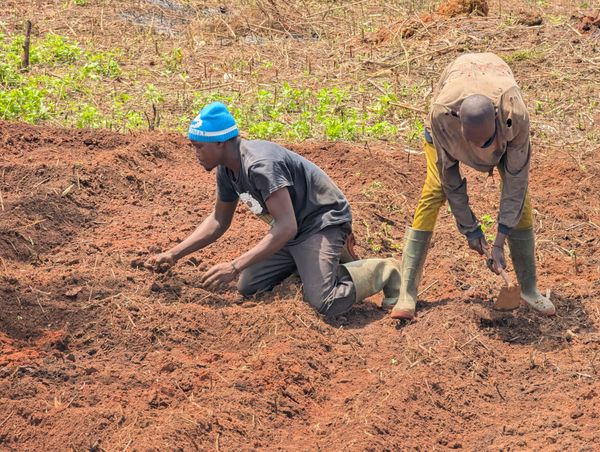
Rather than planting strictly by calendar date, we now train members to watch soil moisture and short-range forecasts before committing seed to the ground, delaying planting by a week or two if rains are clearly late rather than planting on schedule and risking a failed germination. This single adjustment has saved members from repeated replanting costs in seasons where the rains arrived later than the traditional calendar suggested.
Choosing more resilient crop varieties
Alongside timing, crop choice matters. We encourage members to include at least some drought-tolerant traditional varieties — certain indigenous vegetables and grain varieties — alongside higher-yielding but more water-demanding commercial varieties, spreading risk across a season rather than betting entirely on one outcome. Our community seed bank program exists partly to keep these resilient local varieties available to members who want them.
Water storage as a buffer
Rainwater harvesting, covered in more detail in a separate article, has become a central piece of climate adaptation for our members, since stored water lets a household bridge the gap when rains are delayed or end early. Combined with mulching and drip irrigation, storage turns an unpredictable rainy season into something a household can manage rather than simply hope for.
How we track whether our adaptation advice is working
Climate adaptation advice is only useful if it actually holds up against real seasons, so we try to track, informally, how our recommended adjustments perform each year rather than treating the guidance as fixed once written. After a season where rains arrived unusually late, for example, we specifically ask members who delayed planting based on our advice whether that decision paid off compared with those who planted on the traditional calendar regardless, and we adjust our guidance for the following season based on what members actually report.
This kind of informal, ongoing feedback loop matters because climate adaptation is inherently a moving target — advice that worked well two seasons ago may need revision as patterns continue shifting, and we would rather revise our own recommendations openly than present them as more settled and permanent than they actually are.
Sharing what we learn with neighbouring groups
As other community groups and CBOs in the wider Ruaraka area have started similar climate adaptation conversations, we have begun informally sharing what we have learned — which crop varieties have performed reliably under recent unpredictable rains, which timing adjustments have actually paid off — rather than treating this knowledge as something to keep only within our own membership.
We think this kind of informal knowledge-sharing across neighbouring groups strengthens the wider area's collective resilience more than any single organization keeping its observations to itself would, particularly since climate adaptation is inherently a shared, area-wide challenge rather than one any single household or group can fully solve alone.
Adapting to less predictable rainfall is an ongoing process rather than a fixed set of rules, and our own recommendations to members continue to shift as we learn what is and is not working season to season. What has stayed constant is the underlying principle: build in flexibility — in timing, in crop choice, in water storage — rather than committing rigidly to a single plan and hoping the season cooperates. We would also encourage members to treat their own farming experience as a genuine data point worth sharing, not just something to quietly work around. A pattern one member notices in isolation might be a coincidence, but the same pattern reported independently by several members across a season is exactly the kind of signal that helps us refine our climate adaptation guidance for the whole membership.
Key takeaways
- Traditional long and short rains have become noticeably less predictable in recent years.
- Watching soil moisture and short-range forecasts beats planting strictly by calendar date.
- Mixing drought-tolerant traditional varieties with commercial seed spreads seasonal risk.
- Stored rainwater is what lets a household bridge delayed or shortened rains.
Frequently asked questions
How do I know when to actually plant if rains are unpredictable?
Watch soil moisture and short-range forecasts rather than a fixed calendar date, and be willing to delay planting by a week or two if rains are clearly late.
Why grow traditional varieties alongside commercial seed?
Traditional varieties are often more resilient to drought and poor soil, spreading risk across a season rather than depending entirely on higher-yielding but more water-demanding commercial seed.
Is climate change something Green Revolution Farmers takes an official position on?
We focus on practical adaptation for our members' own plots rather than broader policy advocacy, which is outside our scope as a local training organization.
Does this guidance apply outside Nairobi as well?
The general principles translate reasonably well to similar climates elsewhere in Kenya, though specific timing recommendations are calibrated to Nairobi's particular rainfall patterns.